- Watch
The history of the diving watch: from underwater instruments to contemporary timepieces

The diving watch occupies a special place in the history of watchmaking. Originally conceived as a true instrument intended for explorers and professionals in the underwater world, it meets specific constraints: to withstand pressure, remain perfectly legible, and accompany its wearer in an environment where every detail matters. Over the decades, the diving watch has evolved from a technical tool to a timepiece sought for its character, robustness, and aesthetics. Today, the codes of the diving watch remain deeply linked to this history. At Colympha, this heritage forms one of the foundations of our approach to watchmaking, combining maritime inspiration, readability, and contemporary design.
To the origins of the diving watch
When the watch becomes a true instrument
Before the advent of watches specifically designed for diving, underwater activities already required the use of instruments capable of measuring time. For divers, knowing the duration spent underwater was essential, especially when diving techniques directly depended on limited air reserves and precise protocols.
The diving watch thus emerged from a need before being associated with a style. It had to be able to withstand water and pressure while allowing for quick reading in sometimes difficult visibility conditions. Its dial had to be immediately understandable, its needles easily identifiable, and its case robust enough to accompany users in their explorations.
During the 20th century, technological advances in watchmaking and the development of scuba diving allowed these instruments to be perfected. Waterproofness, the resistance of materials, and readability gradually became central features of the diving watch.
The codes that define a diving watch
A diving watch is not defined solely by its appearance. Behind its recognizable aesthetics lie functional choices developed to meet the constraints of the underwater environment.
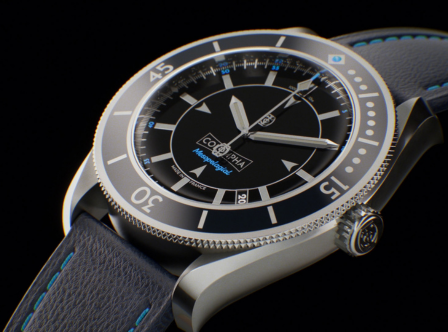
Readability is particularly important. The indexes, hands and dial markings must be easily identifiable. The contrast between the various elements allows for immediate reading of the time, while the luminescent treatments improve visibility when natural light diminishes.
The case is also a crucial element. Its design must protect the movement and ensure resistance suitable for the intended use. The crown, the case back and the various sealing elements all contribute to this protection.
In addition to these technical features, there are now aesthetic codes that have become emblematic: structured dials, marked indexes, easily identifiable hands, and lines designed to combine functionality and character.
From professional instrument to contemporary timekeeping
Over time, the diving watch has outgrown its strictly professional use. Its aesthetics and history have contributed to making it a timepiece appreciated far beyond the underwater world.
This evolution has not erased the characteristics that have shaped its identity. On the contrary, watchmakers continue to rely on these codes to create contemporary watches. Strength, readability, and functional simplicity remain associated with the diving universe.
An aesthetic inherited from nautical instruments
The influence of navigational and measuring instruments is particularly evident in watches inspired by the maritime world. Their design often prioritizes immediate reading and a clear organization of information.
This approach goes beyond mere aesthetic research. It recalls the instrumental origins of watchmaking and the way in which certain objects have been designed to accompany man in demanding environments.
Colympha draws its inspiration from the world of diving and nautical instruments to create a dial whose primary purpose remains readability. The lines, contrasts and various graphic elements are designed to create a balanced overall look that is both functional and contemporary.
The diving watch today
The diving watch continues to evolve its codes today while maintaining the principles that have built its identity. Materials, assembly techniques, and movements have advanced, but the pursuit of robustness, readability, and reliability remains at the heart of its design.
This continuity explains in part the particular place that the diving watch still occupies in contemporary horology. It carries with it a history linked to exploration, the sea, and the instruments that allow measuring and understanding the environment.
At Colympha, this story takes on a different dimension: that of Marseille and the Mediterranean. The maritime universe thus becomes a source of inspiration for creating a timepiece that does not seek to reproduce the instruments of the past, but to extend certain principles into a contemporary interpretation.
The diving watch thus remains much more than just a recognizable style. It is a testament to a meeting between function, technique, and design. A story that continues to inspire watchmaking and that finds new expressions today, notably through French creations such as those by Colympha.
Our other articles